Pinot Noir Red Wine + Rosé Wine Buy in the Online-Shop of the Wine Estate
Pinot Noir – Nobility from Burgundy
Pinot Noir is among the most demanding yet finest red grape varieties. It is often described as the “king of red wines” among those grown in Germany, as few other varieties combine elegance, freshness and fruitiness in such a refined manner.
Typical of Pinot Noir is a fine, clear fruit expression that never appears loud or forward. On the palate, notes of red berries and cherry are common, often accompanied by subtle spicy nuances, supported by an elegant structure and restrained tannins.
The delicate fruit of Pinot Noir shows well across different styles of vinification. Accordingly, our range includes Pinot Noir rosés and red wines, available both as dry and sweet wines.
As both rosé and red wine, dry Pinot Noir accompanies food with precision and restraint, without pushing itself into the foreground. It supports flavours rather than masking them and is therefore well suited to many occasions at the table.
Sweeter styles of Pinot Noir are often enjoyed on their own, but they also pair well with selected dishes, cheese or refined snacks.
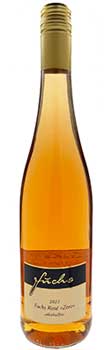
In terms of colour, Pinot Noir rosés show a clear, attractive rosé hue, while the red wines display a luminous ruby red.
Pinot Noir Sites at Weingut Fuchs
Our Pinot Noir is grown on carefully selected sites in both Rheinhessen and the Palatinate.
In Rheinhessen, the vines are cultivated on the gently south-east-facing Dalsheimer Steig and the Niederflörsheimer Steig. In the Palatinate, the Pinot Noir vines thrive on south- and south-west-facing slopes around Einselthum.
These sites meet the grape variety’s high demand for warmth and allow for a long growing season, enabling the slow development of its fine, varietal flavours.
Facts About the Red Grape Variety Pinot Noir
Origin of Pinot Noir
The red grape variety known in Germany as Blauer Spätburgunder is internationally recognised under its French name Pinot Noir; under the name Pinot nero, it is also widely cultivated in Italy.
The variety belongs to the Burgundy family and ranks among the oldest cultivated grape varieties in western Central Europe. Pinot Noir was already known in these regions in the early Middle Ages. It may have originated as a selection from the original Burgundy variety, Pinot Meunier. Its long history and wide distribution make it one of the classic grape varieties of European viticulture.
Characteristics of the Variety
Pinot Noir places very high demands on climate and soil. It thrives best on our warm sites with deep, often calcareous soils, where it can express its fine fruit and elegant structure with particular clarity.
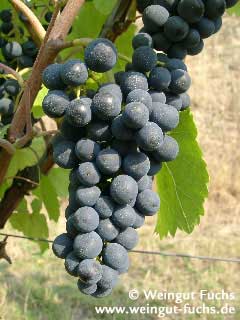
The grapes are medium-sized and compact. The thin-skinned berries are dark blue to violet in colour and strongly pruinate. They yield a light-coloured juice and ripen comparatively late – as the German name Spätburgunder (‘spät’ meaning ‘late’) suggests. This late ripening requires patience, but it favours the development of fine, nuanced wines.
Price per bottle (0.75 l) incl. 19% VAT plus shipping fees
Pinot Noir Sweet, Histamine-Certified
Nutritional Values + Ingredients
100 ml contain on avarage
Calorific value
320 kJ (77 kcal)
Carbohydrates
6 g
of which sugar
5.2 g
Contains negligible quantities of fats, saturates, proteins and salt.
Ingredients: grapes, saccharose, antioxidants: sulfites, bottled in a protective atmosphere.
FAQ – Frequently Asked Questions about Pinot Noir
Is Pinot Noir dry or sweet?
We offer both styles: Pinot Noir is produced as a dry red wine as well as a dry rosé. In addition, it is also available as a semi-sweet rosé and as a sweet red wine. Regardless of sweetness level, both reds and rosés display the grape variety’s typical fine fruit.
Is Pinot Noir low in acidity?
The acidity of our Pinot Noir wines is ripe and well integrated. This gives the wines a soft, rounded and well-balanced impression. Specific analytical values can be found in the individual wine descriptions.
What does the acidity of Pinot Noir depend on?
The acidity of Pinot Noir depends less on the grape variety itself than on harvest timing and winemaking. Very ripe grapes, complete destemming and controlled warming instead of classic maceration lead to a particularly soft, harmonious acidity in the red wine.
Why does Pinot Noir work particularly well with food?
Pinot Noir goes particularly well with food because it supports dishes without overpowering them. Its fine fruit, restrained tannins and deliberately soft acidity create balance and elegance at the table, allowing it to accompany both lighter and more robust dishes harmoniously while remaining discreet.
“Als langjähriger Kunde haben mich die Produkte des Weingutes Fuchs sehr überzeugt. Der Versecco dry hat meine Gäste voll überzeugt. Der alte Weinbrand ist ein Genuss. Wir können das Weingut Fuchs nur weiterempfehlen..”