Dunkelfelder Red Wine Buy in the Online-Shop of the Wine Estate
Grape Variety Dunkelfelder – Intense Colour and Fruit
Dunkelfelder is a modern red grape variety whose origin remained unclear for a long time. Since its official approval in 1980, it has been cultivated in Germany only on a relatively small scale.
The variety is often used as a so-called teinturier grape because its berries contain particularly pigment-rich flesh and an intensely dark juice. Single-varietal Dunkelfelder wines are therefore comparatively rare.
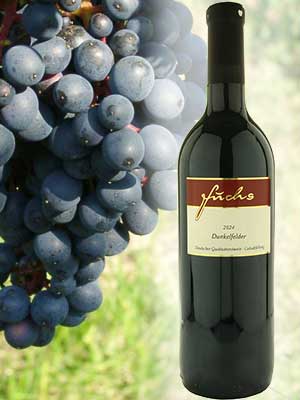
Dunkelfelder red wine from Weingut Fuchs shows density and body. It is a true “fruit bomb”, revealing intense aromas of ripe blackberries and cherries with a subtle caramel nuance.
We vinify our Dunkelfelder as a single-varietal, sweet red wine. Ripe tannins and a fine sweetness harmonise perfectly.
Typical is the deep dark red colour, almost black in appearance, which makes the wine a visual pleasure as well.
Dunkelfelder is a characterful wine for indulgent moments. It pairs excellently with game dishes, hearty grilled specialities and strong cheeses.
Dunkelfelder Vineyard Sites at Weingut Fuchs
We meet the high site requirements of Dunkelfelder vines in a warm, sheltered vineyard location at the Nieder-Flörsheimer Frauenberg in the Rheinhessen part of the estate, as well as on a south-west facing slope at the Klosterstück in Einselthum in the Palatinate. These sites provide optimal conditions for full ripening.
Facts About the Red Wine Variety Dunkelfelder
Origin of Dunkelfelder
The variety was bred at the beginning of the 20th century by Gustav Adolf Froelich (1847–1912). As no breeding records were preserved, its parentage remained uncertain for a long time. Originally, it was assumed to be a crossing of Portugieser and a teinturier grape.
According to the German Winegrowers’ Yearbook, DNA analysis carried out in 2013 finally identified the true parents as Madeleine Angevine and the teinturier variety Teinturier du Cher.
During the 1930s the grape was initially known under the names “Purpur” and “Froelich 4”. After the name “Purpur” was rejected by the Federal Plant Variety Office, the designation Dunkelfelder was chosen – referring both to the wine’s intense colour and to the long unclear origin of the variety.
Characteristics of the Variety
Dunkelfelder can be described as rather capricious in the vineyard. Even for winegrowers like us who appreciate varietal diversity, cultivating this grape remains something of an adventure.
Due to its early budbreak, the variety requires warm vineyard sites protected from late frosts. It is also sensitive to drought and therefore needs deep soils with a reliable water supply.
Dunkelfelder is low-vigorous and produces very small, often irregular yields. Because of the demanding cultivation and limited harvest volumes, less than 0.5% of Germany’s vineyard area is planted with this variety.
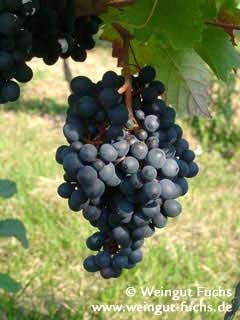
Dunkelfelder grapes are small and blue-black with a waxy bloom. The flesh is very dark and the juice exceptionally rich in colour. Aromatically, the berries show intense notes of forest fruits and cherries. Their acidity is mild, while the tannins are pronounced and appealing.
In specialist literature Dunkelfelder is sometimes described as an early-ripening variety. This is only partly true. If harvested early purely for its colouring properties, it can produce an intensely coloured but rather neutral blending partner.
For high-quality single-varietal wines, however, Dunkelfelder requires full ripening on the vine. Only then does it develop its full potential, depth of flavour and structural complexity.
During the ripening period the grapes are highly susceptible to bird damage, making protective measures essential.
Price per bottle (0.75 l) incl. 19% VAT plus shipping fees
Dunkelfelder Sweet, Histamine-Certified
Nutritional Values + Ingredients
100 ml contain on avarage
Calorific value
312 kJ (75 kcal)
Carbohydrates
5.4 g
of which sugar
4.7 g
Contains negligible quantities of fats, saturates, proteins and salt.
Ingredients: grapes, saccharose, antioxidants: sulfites, bottled in a protective atmosphere.
FAQ – Frequently Asked Questions about the Grape Variety Dunkelfelder
Why is Dunkelfelder so dark in colour?
Dunkelfelder naturally has particularly colour-intensive grape flesh and very dark juice. This results in deeply coloured wines that can appear almost black.
Is Dunkelfelder red wine coloured artificially?
No. The intense colour is a natural characteristic of the grape variety. It results from the high concentration of natural pigments in the grape skins and flesh.
Why is Dunkelfelder grown only rarely?
Dunkelfelder is considered demanding in the vineyard and produces only small, often irregular yields. Cultivation is therefore labour-intensive and not always economically attractive.
Is Dunkelfelder a sweet red wine?
Dunkelfelder can be vinified in both dry and sweet styles. At Weingut Fuchs it is produced as a single-varietal sweet red wine with intense fruit and soft tannins.
{"@context":"https://schema.org","@type":"FAQPage","mainEntity":[{"@type":"Question","name":"Why is Dunkelfelder so dark in colour?","acceptedAnswer":{"@type":"Answer","text":"Dunkelfelder naturally has particularly colour-intensive grape flesh and very dark juice. This results in deeply coloured wines that can appear almost black."}},{"@type":"Question","name":"Is Dunkelfelder red wine coloured artificially?","acceptedAnswer":{"@type":"Answer","text":"No. The intense colour is a natural characteristic of the grape variety. It results from the high concentration of natural pigments in the grape skins and flesh."}},
“Als langjähriger Kunde haben mich die Produkte des Weingutes Fuchs sehr überzeugt. Der Versecco dry hat meine Gäste voll überzeugt. Der alte Weinbrand ist ein Genuss. Wir können das Weingut Fuchs nur weiterempfehlen..”