The Bacchus grape variety – named after the Roman god of wine – is one of the comparatively young modern crossings.
Bacchus is grown relatively rarely. As a typical bouquet variety, it produces full-bodied white wines of a pale yellow colour. Its taste is fruity, harmonious and rich in bouquet, with a delicate hint of muscat. The wines are characterised by a particularly mild, pleasant acidity.
The palate-filling bouquet of Bacchus reveals nuances of mango, passion fruit and ripe pineapple, complemented by the variety’s characteristic finely spicy muscat notes.
Among self-proclaimed “connoisseurs”, Bacchus wines are sometimes smiled at – yet they are especially popular with newcomers to wine thanks to their agreeable, easy-drinking character.
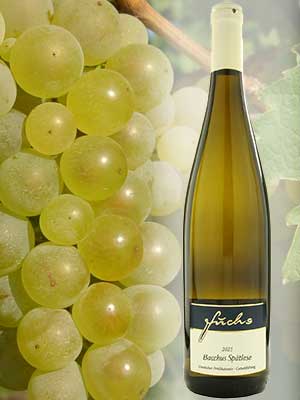
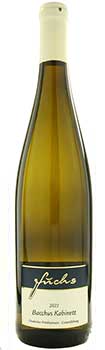
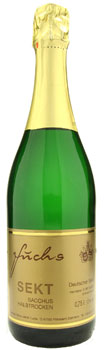
Because of its pronounced aromatic bouquet, we vinify our Bacchus as a sweet wine. In addition, we also produce a semi-dry sparkling wine from the Bacchus grape.
Bacchus wines are true wines for pleasure, delightful even “just on their own” – an ideal terrace wine, an apéritif or a rewarding evening “nightcap”. At the table they pair well with flavourful vegetarian dishes, pork and poultry, sweet-and-sour cuisine, light desserts and cheese.
Bacchus Vineyard Sites at Weingut Fuchs
The Bacchus vines at Weingut Fuchs thrive on both sides of the “border” between Rheinhessen and the Palatinate. On the Rheinhessen side they grow in the warm Dalsheimer Sauloch, while on the Palatinate side of the estate they enjoy an excellent position on a south-facing slope at the Niefernheimer Schnepfenflug with wide views across the Zellertal valley.
Facts About the White Grape Variety Bacchus
Origin of Bacchus
The Bacchus grape variety was bred at the Federal Research Institute for Vine Breeding Geilweilerhof in Siebeldingen (Palatinate). It is a crossing of (Silvaner x Riesling) x Müller-Thurgau from the 1930s and therefore belongs – unlike “classical” varieties such as Riesling or Gewürztraminer – to the modern crossings. The variety takes its name from the Roman god of wine.
Characteristics of the White Wine Variety Bacchus
Bacchus vines prefer deep, nutrient-rich soils and have a comparatively high water requirement. They are therefore not well suited to very dry sites. In general, they favour warm – but not excessively hot – vineyard locations.
Owing to their early budbreak, Bacchus vines are susceptible to late frosts in May. Winter frost, however, rarely poses a serious risk thanks to the good wood ripening of the variety.
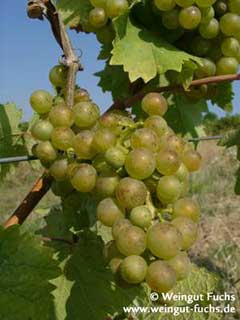
Bacchus grapes ripen early and can therefore achieve very good, high must weights. The bunches are compact; the medium-sized berries are yellow-green in colour and often show slight “freckles”. Their flavour is intensely fruity with a subtly spicy hint of muscat.
Contains negligible quantities of fats, saturates, proteins and salt.
Ingredients: grapes, saccharose, expedition liqueur, stabiliser (carboxymethylcellulose), antioxidants: sulfites, bottled in a protective atmosphere.
FAQ – Frequently Asked Questions about the Bacchus Grape Variety
Why is Bacchus grown less frequently today?
Bacchus is planted less than in the past due to the general trend towards drier and more mineral white wines. Nevertheless, the variety has its devoted fans who appreciate the excellent wines it produces. For that reason, we would find it a pity not to grow it.
Is Bacchus a typical German grape variety?
Yes. Bacchus was bred in Germany and is still grown mainly here today. Internationally, the variety plays only a minor role.
When are Bacchus grapes usually harvested?
Bacchus ripens comparatively early. In warm years, harvesting often begins as early as September. This makes the variety well suited to producing fruity wines with high ripeness.
Is Bacchus difficult to cultivate in the vineyard?
Bacchus vines have relatively high demands on soil and water supply and are sensitive to late spring frosts. In good vineyard sites and with careful vineyard management, however, they can produce very high must weights with wonderful aromatic expression.
Why is Bacchus well suited for sparkling wine?
Thanks to its intense fruit and mild acidity, Bacchus also shows a very pleasant, aromatic style when made into sparkling wine.
“Als langjähriger Kunde haben mich die Produkte des Weingutes Fuchs sehr überzeugt. Der Versecco dry hat meine Gäste voll überzeugt. Der alte Weinbrand ist ein Genuss. Wir können das Weingut Fuchs nur weiterempfehlen..”